

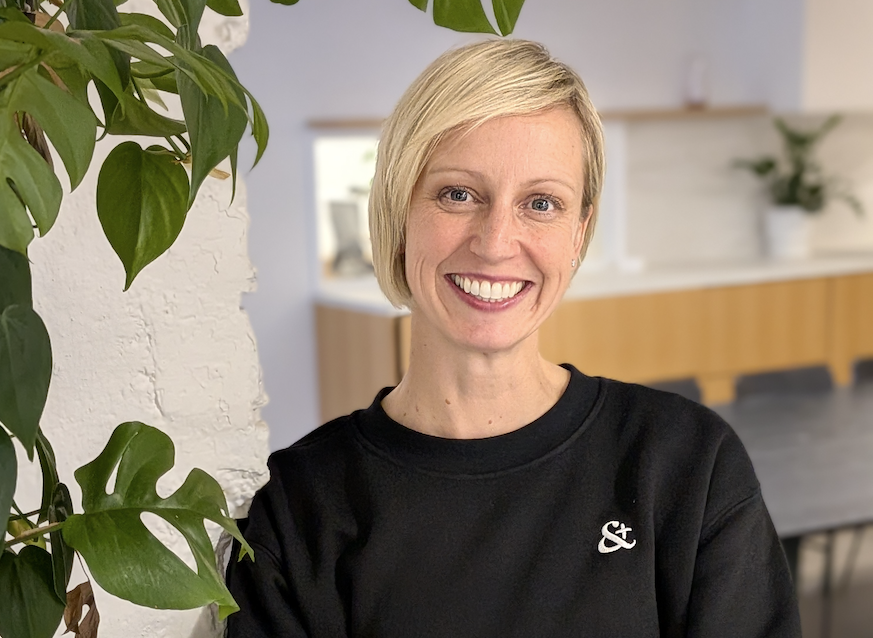
Hannah has been a lawyer, a founder, and is now Chief Operating Officer at New+Improved, where she spends her time making the early-stage chaos for startup building feel more like companies. Hannah works across strategy, structure, and governance to help turn raw ideas into ventures that are actually ready to scale. With experience spanning startups, venture building, and technology law, she brings a mix of sharp thinking, commercial instinct, and a healthy bias toward action. Hannah is driven by a simple belief: great founders, supported by the right structure and community, can create companies that genuinely improve the world. Enjoy getting to know Hannah!
You’ve been a lawyer, founder, and now COO here, at a venture studio. How has that combination shaped how you think about building companies?
It’s made me less romantic about startups, but more optimistic about them too.
The legal experience has taught me to think structurally and in detail: considering risk, governance, being mindful of what happens if things go wrong, and putting structure in place before you get to that point. Being a founder has helped me be resilient and agile, and has shown me that almost none of the technical details matter if customers don’t love your product! Venture studio life sits in the middle: we’re pattern matching across multiple portfolio companies, so you start to see the same ingredients for momentum.
All three spaces have made me biased towards validation, speed and scaling effectively. As founders, we love ideas. But in a studio environment, you see the companies that thrive are the ones that truly understand real customer behaviour and pain and can translate that into tangible growth.
Having sat in all three seats, I’ve probably got a higher appreciation for the human side of venture building. Founders carry an enormous amount emotionally, commercially and operationally. I think a lot about designing systems and governance that helps people build, rather than adding process for the sake of it.
You would have had so many learnings as the Founder of TaxGift. What ones are key for others starting to build their own startups?
Two key learnings stand out: resilience is critical, and solo founding is tough.
Surviving foundership is all about absorbing setbacks without losing momentum. Startups can be harder and slower than you expect in the beginning. You have a brilliant idea (and everyone you tell it to agrees with you!), but translating that idea into a commercially viable business has many moving parts. There are moments where things don’t work, customers don’t respond as you hoped, funding doesn’t follow the expected path, or the plan has to be reformulated. So surround yourself with the right people, and don’t loose sight of finding and solving customer pain.
This leads me onto the other huge learning for me: not to do it alone. I’m a big believer in the co-founder model we implement at New+Improved. The founder journey is intense, and having co-founders who challenge your thinking, share the pressure, and help you through setbacks is invaluable. I love the phrase “strong opinions lightly held”, as having equally invested people bringing different perspectives leads to better decisions and stronger outcomes.
What does your role as COO look like when N+I are on the journey to discover and build a new company?
My role centres around creating a space for portfolio companies to move quickly without descending into chaos. In the early stages, there is so much happening at once: testing ideas, speaking to customers, validating markets and products, building teams, raising capital. I sit across it all, bringing enough structure and operational discipline to the process so that portco teams stay focused on momentum.
I like to see myself as a useful tool for the portcos (and hopefully they see it the same way!). If my role is going as expected, I am smoothing the path for portcos by applying lessons from previous roles and our previous ventures.
My other favourite phrase is “next time it will be easier”. I’m not sure that’s quite true yet, but at least the challenges that crop up with each new venture are different, suggesting we’ve learned and evolved through the previous challenges.
How do you think about bringing structure into chaos without slowing things down?
Processes are about identifying where experimentation is “cheap” and beneficial, and where mistakes become expensive.
The best studio environments are those where the founders feel deeply supported, but not slowed down. There can be an assumption that structure and speed are contradictions. I firmly believe that strong structure and processes enable you to move quickly without breaking things and then spending significant time fixing them, or worse, going backwards.
I’ve always got one eye on a capital raise, and what could be an issue from an investors’ perspective. Testing markets, customer messaging, iterating product features; these are areas where speed is an advantage and too much process or over-engineering can kill momentum. However, losing trust in governance processes, financial controls, legal obligations, IP management have real consequences.
A big part of ops leadership is knowing when and where to introduce just enough structure. It’s got to have an end game of allowing space for founders to make quick, clear decisions and establishing lightweight systems that reduce friction and allow momentum.
How are you seeing AI change the way early-stage companies operate?
For me, the biggest change AI has brought is speed, both in how early-stage companies can operate and in the pace at which the AI landscape is evolving itself.
Since mid 2025 we’ve seen AI develop from a nice productivity tool, to something actively reshaping the way teams operate. Founders can now compress work that used to take days or weeks into hours: the iteration loop has fundamentally quickened. It’s increased the expectation on founding teams as AI has absorbed a large portion of the production and support work that traditionally required headcount. This can be powerful for burn rate management, but if capital is available, it also unlocks the ability to invest headcount into higher-leverage roles.
This increased speed creates tension by raising the importance of judgment. When execution is cheap and fast, decision quality becomes the real differentiator. Founders and early teams must cut through noise and hype to decide what to build and what to ignore. That tension is healthy, and it’s what separates great companies.
What are the biggest blind spots you see founders face when their startup starts to gain traction?
As startups gain traction, the cost of avoiding hard conversations between co-founders rises sharply. What was once implicit alignment in the early days becomes much harder to sustain under pressure.
Early on, everything feels aligned: expectations are low, energy is high, and direction is largely intuitive. But as traction builds, roles diverge and stakes increase. More customers, decisions, capital, visibility, and responsibility and with that comes real pressure and clearer expectations of success.
At this point, unspoken assumptions and culture begin to break down. If the relationship can’t handle direct disagreement, tension doesn’t disappear, it shows up indirectly as mistrust, avoidance, and second-guessing. The key shift is leaning into hard conversations early. Disagreement between co-founders is a healthy and constant reality that needs to be surfaced and worked through and should never be avoided.
In my experience, avoiding these conversations doesn’t reduce tension, it compounds it, turning small misalignments into far more expensive decisions later.
What’s a common startup assumption that you disagree with?
One thing that I see that I am sceptical of is the idea that visibility is the same as progress.
There’s a lot of smoke and mirrors in early-stage startups: press, fundraising momentum, and highly polished narratives can all create the impression that things are working when the underlying reality is still fragile. It’s the classic duck on water: calm on the surface, frantically paddling underneath. I felt this acutely as a founder.
That said, founders should intentionally lean into this, but the key is not mistaking the story for the substance behind it. It plays an important role in building brand and attracting future investors, customers and talent.
Capital in particular amplifies this effect. A strong raise can be interpreted as validation of product market fit, when in reality it may reflect narrative strength, timing, or investor appetite for a category. The risk is that founders blur the lines between attention, capital, and traction, signals that are correlated, but fundamentally different.
A healthy scepticism is essential, and the real test is simple: are customers repeatedly choosing the product in a way that builds a sustainable business?
When you look back years from now, what do you hope your work has helped create?
It goes without saying that as a studio building marketing tech companies, I’d love to have been part of transforming the impact and influence of marketing through the companies we build.
In the short term, I hope that we make it meaningfully easier to build great companies from New Zealand. I’d love us to have played a role in giving founders both structure and confidence, without removing autonomy.
Ultimately though, for me, it comes back to the people. I truly love the startup space, and I really enjoy coming to work each day due to the impact we have. I’d love to look back and see that we’ve created a platform that has brought more people into this world, encouraged entrepreneurship and supported them in creating something exciting.
I never contemplated a career as an entrepreneur or in the startup world when I left school. If New+Improved allows more people to consider this as a viable career and helps founders feel more resilient and supported, allowing them to go on to build multiple ventures rather than burning out after one, I think that would be an amazing long-term outcome.
Outside of work, what tends to recharge you the most?
Super cheesy, but vitamin sea! We’re a boatie family, and my happy place is the water: on it or scuba diving in it. It’s very hypnotic and relaxing - I can spend hours on end just staring at the ocean….
What’s the best piece of advice you’ve ever received?
I vividly remember my Poppa telling me when I was around 8 that “a little knowledge is a dangerous thing”. I love this, I think it’s sage advice to stay curious, keep asking questions and never think that you’ve got all the answers (even if my husband thinks that I think that I do…!).
We hope you enjoyed hearing more about Hannah's journey and learnings! Connect with Hannah here!
