

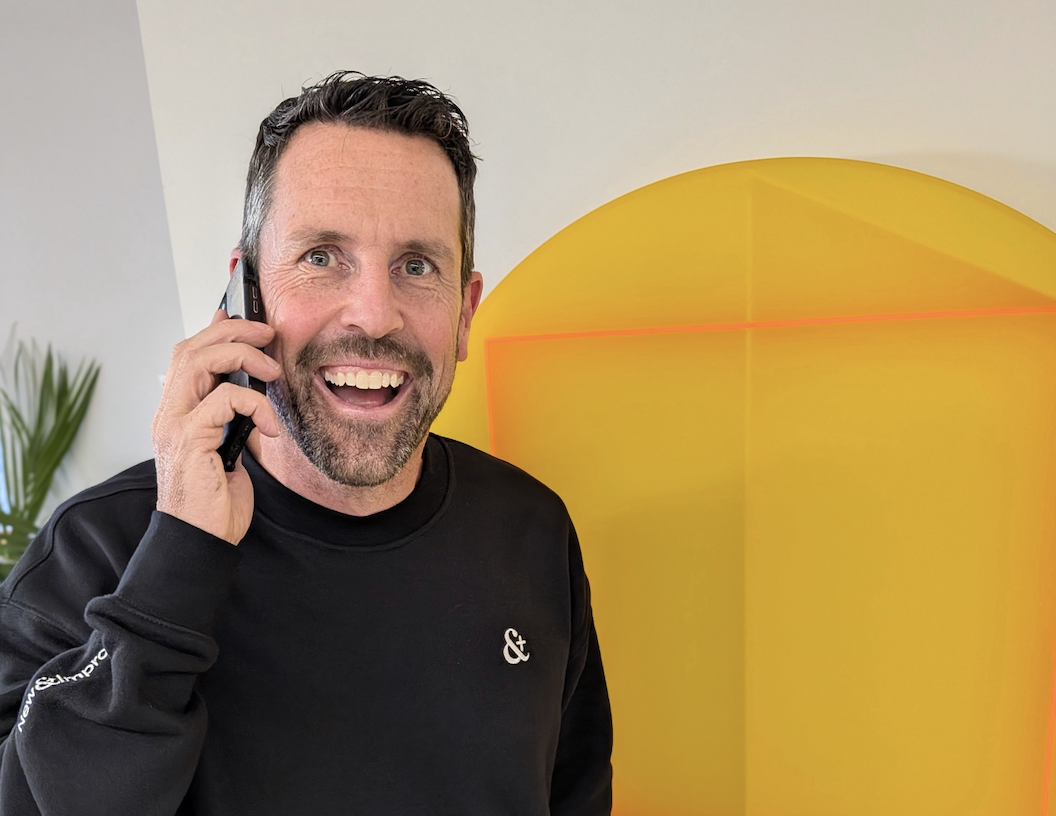
Connon is a Managing Partner at New+Improved and has extensive experience building disruptive businesses. Connon is known for his ability to quickly understand complex problem spaces, shape them into clear product opportunities, and bring together the right mix of founders, teams, customers and investors. Connon also loves a walking meeting, so if you're ever around Grey Lynn, you may find Connon and team stomping the streets. We hope you enjoy finding out more about Connon, his journey and his lived beliefs on how we create valuable, global, marketing tech startups.
You've spent much of your career building and backing disruptive businesses. What draws you to early-stage company creation?
It’s probably fair to say that I’m not a classic startup guy. But I’m repeatedly drawn to this space for two reasons: it is where the opportunity for real impact is greatest and I have a persistent dissatisfaction with the status quo that I can't really switch off.
I’ve worked in global corporates and in the consulting/agency model. Both have lots of pros but the extent of change you can make in the world is pretty limited. In early stage venturing you are literally creating something from nothing, turning an idea into millions of dollars of revenue and perhaps most importantly, into hundreds of jobs. That quite literally is opportunity for impact.
And the dissatisfaction with the status quo is pretty much baked into my DNA. I look at the way industries operate (the assumptions they've built around, the inefficiencies that have been normalised, the budgets being spent on things that don't really work) and I find it genuinely hard to accept that this is just how it has to be. That's not cynicism. It's the opposite. It's a persistent belief that things could be better, if someone asked the right question.
The question I keep coming back to is "what if?" What if brand tracking didn't have to cost a fortune? What if idea testing was fast enough to actually change the course of a business? What if great businesses could make the value equation work for PR? "What if" is where every company starts. It's the moment before the problem has a solution, before the idea has a name, before anyone has tried to monetise it. That's the moment I find most alive.
Studios follow different models. Give us an overview of New+Improved's.
The N+I model is built around a simple commercial question; not "is this a good idea?" but "is this a monetisable problem?" We're looking for pain that is real, recurring, and connected to budget. Pain that people will pay to resolve. Everything starts there.
We generate our own ideas, not waiting for founders to pitch us, not running a startup competition. Chris leads the process where we ideate from the inside, grounded in a deep understanding of the marketing landscape. From there, we run a rigorous discovery process, but the frame is always commercial: where does the budget go, what invoices are you embarrassed to sign off, what work do leaders hate seeing their teams stuck doing? We're trying to locate pain that is visible in real world behaviour, not just in conversation.
Once we have conviction, we validate hard. We're selling from a deck and a clickable mock-up before Ant and Ashish have written any code. This is where the commercial discipline becomes tangible. If customers hand over money before the product exists, you've found something real.
One thing I'd add that often gets overlooked. In startup land people often talk about capital efficiency. But I think at the 0-1 stage, the bigger idea is time efficiency. Our strongest asset as a studio is our ability to accrue learnings rapidly, to compress the feedback loops that would normally take solo founders 12 to 18 months into a matter of weeks. Every discovery conversation, every early sales attempt, every piece of customer signal goes into a shared learning system that makes the next decision sharper. Speed of learning is the real competitive advantage at this stage.
When we have this clarity and confidence, we ask great people to come and work with us as founders and take the venture to the world. Laura leads a process where we look for people who can catch the conviction and spread it to a team and a market. Simon and Phoebe build a brand around the business and finally Hannah helps launch the company as an independent legal entity. It's not a co-working space with shared services. It's a full-contact company creation engine.
N+I builds marketing tech startups. Why marketing tech?
Collectively, the N+I team knows this territory intimately. Ant and I have spent years inside marketing functions, running research programmes and connecting across internal teams and external agencies. Chris, Simon, James and the Previously Unavailable team know the realities of brand and design through a venturing lens.
All of that's not just market knowledge, it's operational empathy. We've sat in those budget conversations. We know what invoices hurt to sign. We understand the difference between a problem a CMO will talk about and a problem they'll actually pay to solve. We're also deeply familiar with what it takes to turn an insight into a scalable SaaS product, and all the ways that can go wrong. That combination of domain depth, customer access, and venture-building experience is genuinely rare. It's why we're the team to do this, and why we stay in this lane rather than chasing every opportunity.
What makes a problem worth building a company around, not just a product?
The test we use is whether the problem shows up in the real world, not just in conversation. Users will tell you they want lots of things. Most of those are vitamins, things that are easy to point to but don’t have any real pain associated with them. A venture-worthy problem is a genuine painkiller, a recurring issue that's visible in budgets, in time, in the choices people and organisations make every day. These are the ones that create real emotional weight when you get close to it. You can hear it in people's voices. You can see it in their faces. That visceral quality matters.
Beyond the pain test, the commercial test matters equally. A company requires a problem that's big enough to justify repeated purchasing, and an ICP that you can actually find and sell to, at scale. I think of it as monetising pain. Can you package the resolution of this problem in a way that creates a recurring revenue model, a distribution motion that compounds, and a customer who renews because the pain will return without you?
The mistake I've seen, and made, is confusing a problem with a venture-scale problem. Both are valid. But only one is big enough to justify the capital, the founding team, and the ambition required to build a company around it. The question isn't just "does this hurt?" It's "does this hurt enough, for enough people, often enough, that they'll keep paying for the relief?"
How is AI changing the way you think about evaluating new venture ideas?
AI has made the bar for validation both lower and higher at the same time, which sounds contradictory but isn't.
Lower, because you can now prototype, test and iterate faster than was possible two years ago. The cost of a proof of concept has dropped dramatically, which means you can get to real customer signal sooner.
Higher, because the signal itself has become harder to interpret. In a hot AI market, buyers have discretionary budgets to experiment. They'll pay for a pilot that they won’t renew if it doesn’t deliver clear, recurring value. As a result, early and rapid ARR isn't the pure signal it used to be.
What gives me conviction faster now is specific, operational usage. Is the product delivering the value the user wanted, is it rapidly getting better, would they renew tomorrow? These are the questions we’re increasingly asking.
Looking across the companies you've built, what have been the biggest drivers of early success?
There is one consistent and recurring theme. Unscalable momentum.
I constantly point people to Paul Graham’s piece about doing things that don’t scale. In the early days, the speed at which you can learn is critical and how quickly those learnings can be turned into small victories and accrued has been key to the success in Tracksuit, Ideally and now Drumbeat.
Unscalable momentum is about selling from paper before we’ve written code, delivering something manually before it hits the product roadmap and prioritising progress rather than perfection. The best early teams I've worked alongside treat sales, hiring, product build, customer success and investor readiness as part of the same moving system rather than a neat sequence of stages. When those things run in parallel, the company accelerates. When one stalls, everything else tends to slow with it.
You've been quoted "Great businesses are partly a good idea, but mostly great founders." What qualities or signals do you look for in individual founders, and then the founding team?
The first thing I'm looking for is whether they can catch the virus. Can they absorb the enthusiasm, urgency and conviction around the problem and then become a carrier, spreading that belief to a team, their customers and the market?
The best founders I've worked with don't wait for perfect definition before starting. They move before everything is resolved, and that movement is magnetic. It attracts people to be part of something, both customers and employees.
At the individual level, I also want to see ambition that matches the opportunity. We’re looking to build businesses that make a mark on the world. And therefore founders need a genuine desire to build something that creates a real change in the world, and don’t purely say “I want to build a nice product”.
We look for startup or SaaS experience, because the learning curve from corporate to startup is steep and can cost you 12 months you don't have. Founders need to handle ambiguity and pressure. This is why we bring potential founders into the tent early, working alongside us through discovery and first sales, sweating the same things we're sweating. Founding a business is really tough, and you don't really know how someone operates until you've both been through ambiguity and pressure together.
Do you think venture creation is more art or system, or both?
I’d like to think the way we’re creating ventures reflects a better way, where there is both more art and more system.
The traditional venturing model (someone creating something in their garage, getting VC funding if they’re lucky and going from there) sees one in 10 businesses break through and be successful. My personal point of view that a smart venture studio model like ours, working in combination with venture capital, can drive much better success ratios.
Our expression of venture creation is art and system operating simultaneously. The system side is what makes venture creation repeatable: the discovery process, the commercial validation discipline, the founder recruitment framework. If you don't have a system, you're purely hoping, or you’re crafting a new solution each time.
The art side is everything the system can't capture, the judgment call about which problem has genuine emotional weight, the instinct for which founder has the right kind of fire, the read on when a market is ready for a new product and when it isn't.
The way I think about it is like a Polaroid picture developing. Early on, the image is murky; you have a signal, some early customer conversations, a problem that seems real, but you can't quite make out the full picture yet. The system creates the conditions for the image to develop: the right discovery questions, the commercial validation tests, the early sales discipline. The art is in knowing how to hold the picture while it develops, when to act on a partial image, when to wait for more clarity, and when to accept that this particular shot didn't come out and it's time to take another.
What's a career mistake you've made that still makes you laugh now?
Early in my career, I naively thought that bigger businesses made better decisions.
I spent time in corporate roles, stints at places like Chevron and Best Buy, genuinely believing that the quality of thinking and information was what determined how decisions were made. It wasn’t. Often in corporate contexts like that, decisions are not made. They’re perpetually deferred until the outcome defaults to the status quo.
I remember realising that the only reliable way to influence anything was to engineer accidental collisions in the hallways. Wandering the floors at the right time of day, "bumping into" the right person on their way back from a meeting or the bathroom, and somehow turning a 30-second interaction into a decision that would have taken three weeks through official channels. I found the whole thing equal parts absurd and fascinating.
That experience taught me something I've never forgotten: hierarchy isn’t a better way of making decisions. It slows them because the system is optimised for control, not clarity. Every business I've been part of since has been a deliberate rejection of that model. The clarity of the decision context and the speed of learning matters more than who in the organisation makes the call.
When you look back years from now, what do you hope your work in venture building has contributed to?
When we were first dating, my wife Tina asked me what I really wanted to do when I grew up. I told her I wanted to help great Kiwis start great businesses. She asked what that actually meant. Fair to say I had little idea and didn’t impress her with my follow-up response. But that question never left me. And it turns out that's exactly what I've grown into doing, I just needed about two decades of iterating toward it to understand what it actually looked like in practice.
When I look back, I hope what I've contributed is a proof point: that you can build globally significant companies from New Zealand, repeatedly and intentionally, with a model that others can learn from and build on. The companies are the most visible output, but the thing I care most about is the method. If N+I can demonstrate that venture creation is a learnable, improvable system, that you can get better at finding the right problems, recruiting the right founders, reading early signals, and structuring companies for long-term success, then that will have the longer-term and wider impact.
What's a hill you'd die on?
As Kiwis, we have to make growth more central. And I mean that personally, not just as a talking point.
I look around at our corporate leaders and see plenty of people willing to talk about growth, many willing to make speeches about ambition, but few willing to do something about it. Too many of the large businesses in this country are optimised to maintain a customer base or protect a dividend flow, rather than find new pathways to new revenue or genuinely move the country forward. Decisions get deferred. The status quo wins by default. And a generation of talented people sit inside those organisations wondering why nothing changes.
But here's what I also know: New Zealand produces genuinely world-class entrepreneurs. The raw material is here. What's missing is the infrastructure around it and the permission to think globally from day one. That gap is exactly why I'm building New+Improved.
N+I is my answer to this hill. We're not commenting on the problem, we're trying to be part of the solution. Every company we create is a bet that a great Kiwi idea, built with the right method and the right people, can compete and win on a global stage. If we can do that repeatedly, and if others can learn from the model and build on it, then maybe we move the dial on something that speeches alone never will.
What would your team say about you?
He gets things done, sometimes before we've even agreed the plan. He's the one who turns a vague idea into first steps and gets us moving. He sees potential in ideas and people that they don't always see in themselves. He can be a lot when you're not in the same headspace, and he definitely sets a fast pace. But when something needs to happen, you want him on the team.
What's the best piece of advice you've ever received?
I've never actually talked about this with my dad, but it came from him. I was a teenager, rummaging through his top drawer looking for money for an upcoming date (as teenagers do) when I stumbled on his journal. There were pages of messy drawings and notes, and then one line that stopped me: "Sophistication is the inability to enjoy simple things."
I didn't fully understand it then. But I've thought about it a lot since. In a world that constantly rewards complexity, complex strategies, complex organisations, complex ideas, it's a radical statement. It's given me a framework for valuing small moments: the early customer conversation where something clicks, the team pulling together under pressure, the first time a founder texts to say they've sold something they didn't think they could sell. Those are the things that actually matter. I've tried to build that sensibility into how I work. Constantly seeking simplicity rather than complexity, finding the joy in tiny triumphs, and being genuinely present for the moments that don't make the investor update but make the whole thing worth doing.
We hope you enjoyed getting a deeper look into Connon’s journey and perspective. Connect with him here!
