

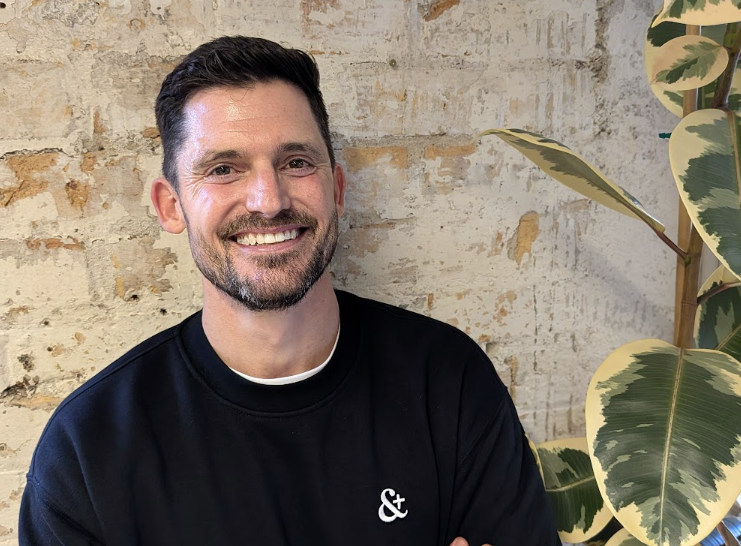
Chris has spent more than 20 years working across engineering, consulting, innovation, venture building, and just about every stage in between. As a Partner at New+Improved, he sits at the intersection of ideas and execution, helping uncover meaningful problems, rapidly prototype solutions, and turn early concepts into ventures with real traction. A self-described venture studio evangelist, Chris brings together the technical, commercial, and human sides of company building, and has played a hands-on role in ventures including Ideally, helping support the company from inception through to its $100m Series A.
You've worked across engineering, consulting, innovation, and venture building. How has that shaped the way you approach building companies?
I think one consistent thread across all of those disciplines is systems thinking. In engineering, you're learning how mechanical, electrical, and software systems interact to solve a problem. In management consulting, you're doing the same thing at a business level, understanding how functions, processes, and commercial dynamics fit together, then working out how to improve them. Innovation adds a forward-looking dimension - what can this system become? What are the opportunities to create entirely new products or services that unlock growth?
Venture building is the most exciting version of all of that. You're starting from nothing, with the privilege of building every system from the ground up - the product, the team, the capital strategy, the customer relationships. And you get to watch them work together and evolve in real time. Ventures are a growing, interconnected system, and every part affects every other part.
What I've taken from all of those experiences is that some of the best ventures are both deeply complex and beautifully simple. You have to understand the full complexity of the problem space you're solving, the market you are in, and how all the parts of a venture need to fit together, but then everything you build - the product, the pitch, the proposition and business model should end up feeling super clear, simple and easy to communicate. Creating something genuinely elegant out of all those possible paths and moving parts is one of the aspects I find most rewarding about building new companies.
What originally pulled you toward venture creation?
Venture creation is a pretty unusual marriage of creativity and commercial rigour, and I think I'm drawn to it because I genuinely love both sides of that equation. The idea of creating something where nothing existed before - a product, a team, a business - and watching it grow into something real is something special. Layer on top of that the fact that I'm a bit of a nerd when it comes to technology, business problems, and the leading edge of innovation, and it just fits.
I also have a fairly short attention span, which sounds like a flaw but is actually a decent asset in this world. The intense zero-to-one phase of finding, building, and establishing a venture is N+I’s sweet spot. Once a business has real traction and a great team driving it, I naturally find myself drawn back toward building something new.
That said, the ongoing Board and advisory roles we take remain pretty hands on as they go from Seed to Series-A. We continue to support the team, help shape the venture and set them up for successfully scaling. This too is massively rewarding, but this has to be balanced by turning our attention back to finding and creating the next venture. I've always been a builder, someone who needs projects and needs to be making something. Venture building is about as good as it gets.
Can you walk us through discovery. What it is and how you approach it?
The discovery phase is the process we use to identify where to build our next venture. It's how we go from a broad thesis to one specific venture opportunity we have real conviction in.
We approach it in two major phases. The first is about understanding problem spaces. We start with the studio’s ever evolving venture thesis with explicit scope of building tech+AI-enabled SaaS solutions that solve meaningful problems for, and increase the impact of the world’s marketing organisations. We then look at that challenge through a set of different lenses that provide focus and a perspective on the world we are solving for. Where are the budget lines that don't deliver enough value? Where is proprietary data held tight that could be unlocked? Where are the challenged agency and service provider relationships that could be replaced and improved by brilliant software solutions? We do an initial desktop phase to generate a range of hypotheses from that lense, then follow that with deep conversations with experts, agencies, data providers and future customers - anyone with a sharp perspective on the space.
The second phase is about moving from problem spaces to validated solutions. We typically run three proto-testing sprints where we create rough, deliberately low-fidelity prototypes and test them iteratively with potential customers. We're narrowing the funnel the whole way through, going from, say, thirty problem spaces early in the first phase down to three, each with a number of possible solutions. Then in the second phase we take those three problem spaces and their various possible solutions down to one winning venture idea with a big, validated problem, an ideal customer profile (ICP), a compelling pitch and proposition, an MVP to start building, and customers already signed up. And if we’re lucky, a pipeline of additional potential ventures to come back to later.
From start to finish, it typically takes four to five months. It starts off feeling vague, uncomfortable and we often say ‘whip-lashy’, as you hunt for clarity and consistency in the signals, which come and go with every conversation you have. But by the end we have clarity, focus and strong convictions in the ventures we decide to take forward.
How has the discovery phase changed over time? Does the market and AI play a part in changing any part of the process?
It's changed significantly, and AI sits on both sides of the equation - as a genuine opportunity and also as a real challenge to navigate.
On the challenge side: every time we enter a discovery phase now, we have to ask harder questions about the spaces we're considering. AI is disrupting all early-stage SaaS businesses, and valuations of both listed and private B2B Saas companies have taken a hit as investors question whether the value they've built is sustainable. There's a genuine risk that what a startup spends a year building, a large model lab could replicate or render irrelevant within months.
So, at the discovery stage, we're not asking "do we have a moat?" as that question is mostly premature and can be a distraction. We're asking something more fundamental - is this a problem space with real, durable pain that isn't going to be solved by a general-purpose model? Are we starting somewhere that gives us the chance to build something genuinely worth defending later? Getting that foundation right at discovery is what matters, even if the thing to defend comes much later.
On the opportunity side, it's been transformational. The quality and speed of desktop research has changed dramatically. Our ability to prototype, both in pace and fidelity, has improved enormously, though we still choose to prototype at low-ish fidelity, not gold-plated vibe-coded functioning apps. One of the most fundamental gains is in how we process information. Every interview transcript, every piece of research, every customer conversation gets pulled into a system that helps us connect the dots faster. It's created real capacity in the discovery phase, and we're constantly experimenting with how to push that further.
Why is the discovery process so critical to New+Improved?
Because it's how we find the opportunities worth building. Without it, we're guessing. And in venture building, guessing without evidence can get very expensive in time, capital, and the focus of really talented people.
It's also what gives us conviction. When you've done the work - the market mapping, the customer conversations, the prototyping and validation sprints - you come out with a view on the problem space and the potential of ventures that you genuinely can't get any other way. That conviction matters when you're recruiting a founding team, raising capital, and making the early product decisions that set the direction of the whole venture.
And it's not just about the next venture. A good discovery phase builds a pipeline. You almost always come out with more interesting ideas than you can pursue right now, and some of those become the ventures you build next. And that’s not to mention the lessons you learn when you get any part wrong. It all makes the venture studio model stronger with each cycle.
Are there common pitfalls you consciously try to avoid during the discovery phase? How do you avoid these?
The biggest one is what I think of as the honey trap of a great solution that’s not grounded in a real and painful enough problem. It's incredibly tempting to jump to a solution early. Solutions are exciting, they give you something concrete to pitch, something to build energy around. But if you haven't really understood the problem, you'll pay for that later. Nine times out of ten, the solution you loved in month one looks quite different by the time you've done the real work.
We hold solutions deliberately lightly in the early stages. We talk about them, sketch them out, but we don't fall in love with them. We're also really deliberate about language. There's a meaningful difference between a problem and a solution, and it's surprisingly easy to conflate the two when you're deep in the process.
The other pitfall for me personally is watching out for when things get too complex or too theoretical. As I said, I’m a systems thinker, which means I naturally want to understand every part of how something works. That's useful, but there's a useful tension between understanding the complexity and moving at the pace a discovery phase demands. You have to make haste slowly in the right moments, and go fast in others. Knowing which is which and when to switch modes is a skill in itself, and one of the reasons having a good team around you with different instincts matters so much. It’s a team sport.
What does strong validation actually look like beyond "people said they liked it"?
One of the first things that springs to mind comes from the idea of making your prototypes intentionally rough. It's counterintuitive as we could build a fully functioning prototype in a day or two with today's AI tools. But we deliberately don't. If you make something shiny too early, you run the risk of getting false positives. People respond differently to polish. What you want to know is whether the problem is real enough that someone wants to pay real money to solve it even when the solution looks like a slightly crappy sketch on a page.
If you put something basic in front of a potential customer and they still lean forward, still want to know more, still want to sign up, that's a meaningful signal. If they only get excited once you've built something beautiful, you haven't validated the problem. You've validated their taste in product design.
The other critical test is commitment. We're asking people to sign up and pay for a 6 or 12-month subscription on something that doesn't fully exist yet. "I love it, you should build it" is easy to say. Raising a purchase order is not. The moment you ask for money, the quality of the feedback changes completely.
But that first commitment is really just the beginning of building genuine conviction in a space.
Two other things matter enormously at this stage. The first is what sits adjacent to the initial slice of value. The MVP is by definition a narrow starting point, and what we're also probing in those early customer conversations is whether there's meaningful opportunity upstream or downstream in the customer's workflow. Can we see a natural path to solving more of their problems over time? Does the territory around the core idea show real promise? If the answer is no and the MVP is essentially a dead end, that's a signal worth taking seriously regardless of how much people like the first version. Sometimes that opportunity takes time to confirm, but you tend to get a sense early if you’ve built a good understanding of the space.
The second is what happens after the discovery phase once a MVP is actually in someone's hands. In the current AI environment especially, early ARR from new customers can be a misleading signal. Buyers are more willing than ever to trial something new, and that willingness doesn't always reflect genuine, recurring value. What builds conviction at that stage is usage; are customers actually using the product, are they getting the value we promised them, would they renew tomorrow if they had to decide right now? Those metrics become at least as important as ARR growth, and in many ways more so. They're the ones that tell you whether you've actually found something real.
How do you think the studio model will evolve over the next few years?
I'm a genuine evangelist for venture studio models, so I'm probably biased, but I think we're still in the early innings of what studio-based venture creation can become.
Every venture we launch sharpens the playbook. We learn from what works, from what doesn't, and from the specific ways each venture is different. The cadence at which we can identify, validate, and launch is already accelerating, and I think that will continue.
One of the most significant changes we've made recently is the Entrepreneur in Residence programme. Bringing potential future founders into the studio during the discovery phase before any venture is launched changes things meaningfully. It's a genuine two-way interview. We get to see how they think, how they work, whether the chemistry is there. They get to see whether this is the right environment for them to build their next venture in. It's a much better foundation for a founding team than bringing people together on day one and hoping it works.
But I'd be doing the model a disservice if I made it sound purely like a system to be optimised. The playbook matters, but vibes still play a real part in discovery, and I mean that seriously. Gut instinct about whether a problem space has genuine energy behind it, whether the timing feels right, whether a particular founder has the right kind of fire - that stuff still carries real weight. The discipline we try to apply is to not let instinct substitute for evidence, but to make sure that when the instinct is strong, we work hard to build the investment case around it. The system creates the conditions for good judgment to operate. It doesn't replace it.
What does a company that is truly set up for long-term success look like to you?
It comes down to people - specifically to the chemistry and character of the founding team.
The things I look for are hunger and something to prove. The founders who go the distance tend to be the ones who aren't just motivated by the intellectual challenge or the financial upside. They have a real drive to show what they can do, and they're willing to grow through the difficult parts of the journey rather than around them. That energy has to be genuine, and it has to be shared.
Product leadership and product velocity have also become increasingly essential. How quickly you can learn from customers, iterate, and ship is a massive determinant of success in the early stages. Slow product cycles kill ventures that might otherwise have found their feet.
The other thing I keep coming back to is the combination of near-term focus and long-term vision for a venture. The best founding teams are laser-focused on the next customer, the next feature, the next dollar of ARR, but they also carry a clear picture of what this business becomes at scale. That north star doesn't constrain them. It helps them make better decisions at every stage, and it's what makes the difference between getting to $1m of ARR and getting to $10m, or $100m of ARR.
What foundations do you think need to be in place early for a company to scale successfully?
The foundation is simple, even if it isn't easy: get things done, prioritise growth and/or learning at any cost, and don't spend energy on process and structure before you need to.
Early-stage founders should be doing a lot of things that don't scale. That's the point. Your job is to learn as fast as possible about your customer, your product, your market, and to keep moving. The moment you start building infrastructure prematurely, you're trading execution for comfort.
That said, the things you can't ignore will eventually make themselves known. The skill is knowing which dumpster fire to deal with and in what order. Not everything that's burning needs your attention right now.
One of the real advantages of operating within a studio is that much of the noise that typically pulls early founders away from growth can be absorbed. Capital access, governance, operations, hiring support, technical development are all the things that matter but don't need the founder's direct attention every day. That frees the founding team to do what only they should do: sell, build relationships, hire an early team, drive product velocity, and find and retain the right customers who will pull the business forward.
What's something happening in startups right now that genuinely excites you?
What genuinely excites me is the blurring of venture functions - specifically what's happening at the intersection of product, design, and development.
As traditional development evolves from writing code to writing prompts for AI to write the code, something fascinating is happening to the shape of those roles. Dev is bleeding into product. Product is bleeding into design. And the inverse is true too. What this means in practice is that product taste and design taste become the fundamental requirements. The person orchestrating the build, directing the AI, deciding what gets built and what doesn't, has to have genuine aesthetic, UX and commercial judgment. You can't delegate that to the model.
There's a brilliant opportunity opening up for generalists with great product taste. Not narrow specialists defending a function, but people who can hold the full picture - the customer pain, the design direction, the product logic, the build, and move fluidly between all of them.
Play it out further and what naturally follows might be the bleeding of customer success into this hybrid function too. The best CS teams sit on a goldmine of product intelligence as they see real signals, friction points, the "I wish it just did..." moments. In a world where a hybrid product/dev/design person can act on signals immediately, that feedback loop will accelerate even further.
Which raises a genuinely interesting question: could a customer ask for a feature and have a beta version on their screen in 30 minutes? Technically, maybe soon. But the constraint won't be speed, it will be judgment. Who decides what's worth building, and what the right version of it actually is? That's the function that matters.
What's a belief you hold strongly that most people in startups would disagree with?
And here's where I want to almost immediately contradict myself.
I just made the case that inspiration and true creativity are the irreducible human edge in a world where build speed is no longer a moat. I believe that. And I'm also not sure it will remain true.
The belief I hold that many people in startups would push back on is this: I'm not convinced humans will remain the source of truly original creative thought for very long. And I find that both fascinating and unsettling.
Here's an uncomfortable thing about human creativity we don't like to admit - we're not as original as we think we are. We're extraordinary pattern recognition machines. What often feels like creative instinct (the pull toward a new idea, the sense that something is right) is often familiarity in disguise. Growth and strategy tend to follow playbooks. Features and product evolution can follow logical arcs. Even bold decisions are often recombinations of things we already know.
Which means AI might not be as far from that as we'd like to believe. I can easily see a world three years out where our AI partners are operating at the creative level of >95% of us.
The question that leaves is what's in the remaining 5%? Maybe this is where competitive advantage ends up living?
My hope is that the bulk of the truly original creative brilliance in the venture scene stays human. We need those visionaries who can see round corners, uncover big problems and create genuinely novel solutions to keep inspiring us. I’m not sure this journey will be nearly as fun if AI is driving the whole way, and choosing the music.
What’s the best piece of advice you’ve ever received?
I have two.
Firstly. The best advice I've received was from a professional coach who said: “Find a line of work that lets your natural tendencies be a superpower rather than something you have to suppress, and then surround yourself with the people who complement those tendencies, and can keep you from getting yourself into too much trouble”.
For me, that's meant leaning into the things I'm genuinely wired for, like the zero-to-one phase, the problem space, the point where an idea is still just a set of hypotheses and energy. I'm not the person who should be running a 200-person business. I've made peace with that. Venture Studio models are, in many ways, a structure built around this idea. They’re designed to play to a particular kind of builder instinct and then hand the baton to the right people at the right moment.
The second half of the advice matters just as much. None of what we do at N+I works without the team mix of brilliant, talented people with complementary strengths and weaknesses. That mix is everything.
Second. Someone shared this advice with me a few years back in a completely different context: “Unspoken expectations are premeditated resentments”.
It stuck with me, and this simple truth keeps proving its mileage.
In venture building, the relationships that fail - between co-founders, between studios and founding teams, between early employees and the business - rarely fail because of a lack of talent or commitment. They fail because people were operating against completely different pictures of what success looked like, what the role meant, or what was expected of them, and neither of them said it out loud until it was too late.
We try to build explicit alignment into how we work with founders at N+I - on the shape of the opportunity, the role of the studio, what the relationship looks like as the venture grows. Not because we're process-heavy, but because the cost of misalignment compounds fast in an early-stage company. Stress amplifies everything. What feels like a small gap in expectations at day one can become a real fracture by month six.
The advice applies personally too. Say what you need. Say what you expect. Say what you're worried about. The conversations that feel awkward to have early are infinitely easier than the ones you're forced to have later.
We hope you enjoyed learning more about our discovery process and about Chris himself. Connect with Chris here!
